
Showing posts with label catastrophe theory. Show all posts
Showing posts with label catastrophe theory. Show all posts
Wednesday, April 13, 2011
Dead Hearts
I believe in reporting failure. The Hungarian Hearts I planted are dead. Clearly too soon. It didn't get down to freezing, but they clearly didn't like the 40s and 50s F.
I planted 16 new seeds. I probably have a month before things should really be planted. I may just plant them a little late.

Sunday, December 5, 2010
First Snow's Effects
I spent the week helping James drive from Utah to Quantico, home being the penultimate stop. It snowed yesterday, which has left a very nice couple of inches that look good on the lawns and trees, leaving the roads and driveways clear.
I was anxious to wake up this morning and see how my new cold frames had done. This was not a big snow, so the maximum stress on the engineering wasn't going to be tested. Still, I was anxious to see.
 Two of five cold frames looked very good. There was a little contraction on the oldest cover because the weight of the snow pulled the ends up. This left a small gap at either end where the plastic separated from the wood of the raised bed. I'm not sure what damage, if any, this might have done by letting colder air inside the bed. I certainly like the cut of the latest cover best. It seemed to keep things sealed nicely all around.
The other three beds did not do so well. Evidently, while we were traveling, there were strong winds and a tornado watch. I had strapped each of these three covers down on the ends, but didn't bother to secure the sides, even though I did have bungie cords there. I guess I assumed too much.

I believe the onions and garlic will do just fine. The photo below is of the onions (yellow of Parma in this case). In fact, the snow may have killed off some weeds, although I don't know that just yet.

 The garlic will also probably do just fine. I will re-attach the cover shortly and assume that the snow will just melt and keep the garlic and onions watered.
I am most concerned with the cauliflower and Brussel sprouts. My experience in the past is that brassicas don't like to freeze. The broccoli were covered, so I am hopeful about them. But these others took it on the chin. I will re-attach this cover, too and will check them. If they are dead, I will know shortly. Perhaps, now that the damage is done, I will actually strap down the sides. But, this may be a catastrophe from which they won't recover and it will just be a loss.

Sunday, June 6, 2010
Mutual Funds
The last time I felt like this was in October, 2008 when I started asking myself if it was time to move everything from mutual funds into money market funds. That time, I didn't act and have regretted it ever since.
Last month (March 2010), funds lost about 5.5% of value. Sometimes you say to yourself, "It is just a blip; things will come back." But there is nothing to base that kind of optimism on. Europe is a mess. The oil spill in the Gulf of Mexico is unabated. More than anything else, there is a feeling of angst.
So, I pulled the plug and moved everything out of a stock-based mutual fund into either a money market fund or a bond fund. I made my trade at the end of March and, based on how mutual funds operate, the trade occurred on June 1. I was out of town attending a conference this past week, so I haven't really assessed my current status.
Reading Reuters and the NY Times suggests I am not alone in heading for the exits at this point in time.
The only remaining question I have is about the potential for another point of catastrophe like the one that happened back in 2008. I am using my understanding of Catastrophe Theory on this: a sudden, non-linear, irreversible change precipitated by an incremental shift. Last time, the plunge was precipitated by home mortgage defaults. (I've recently read Michael Lewis' The Big Short.) I'm not sure what may precipitate the next slide over the cusp; but there are a host of possibilities, including the fact that the causes underlying the first crash weren't really resolved and an economic equilibrium was never actually achieved. So, in addition to the new economic problems that have emerged in Europe, the older problems persist.
I imagined this past week thinking that I really need to understand how seemingly unrelated events actually work as cascading catastrophes. For example, the problem with the PIGS (Portugal, Ireland, Greece, and Spain) economies has nothing directly to do with either the volcano in Iceland or the oil spill in the Gulf. Similarly, the stock market crash apparently had nothing directly to do with the runs on the banks that followed a year later or the dust storms of the years that followed that. But somehow, these unrelated events do add up to instigate catastrophe events.
Friday, May 14, 2010
Lament
Today was a day to see the hives. It started well, but unfortunately ended badly. I don't mind documenting my failures. This was one.
The hive at Clarence Brown's was crowded and had a swarm cell two weeks ago Sunday when we looked at it. My goal today was to verify that the swarm cell had a queen larva and get ready to split the hive tomorrow if that was the case.

Doug Shaw and I opened the hive as we had been instructed by lifting up the super from the back to view the swarm cell. Unfortunately, the bees had put so much wax between the brood box and the super, that when we lifted the super, we ripped the swarm cell apart. I was doing the lifting, Doug was doing the looking and he could immediately see that the new queen had been dislodged. You can see how much burr comb there was in the photo above.

The new queen would not survive. Sudden, irreversible. A catastrophe. The only solution would have been to not have inspected and to have let the hive swarm. But, that isn't a preferred option and not one we could have reasonably anticipated. I saw that there was a lot of burr comb when we examined two weeks ago, but I didn't put the pieces of the puzzle together.
Now I am just sad. It is like having a death in the family.
Perhaps they will start another swarm cell. The hive is still crowded, but there is a queen excluder between the two supers. If they stay together, I expect a lot of hone from that hive.
The other hives are fine. There is evidently a queen laying in the blue hive, but she is producing a lot of drones.

I am not sure what she is up to. I hope she can actually lay fertilized eggs. There is a lot of honey and pollen in the brood frames, so I hope she actually has room to lay eggs as well. Time will tell. For now, they are a happy hive, even if they are slightly odd.
I added a super and more syrup to the yellow hive. The queen in that hive is laying nicely, but it is the weakest hive right now.

I am still just very sad to have lost the baby queen.
Sunday, December 20, 2009
Cold Frame Post Mortem
A photo is worth a thousand words, but still needs to be interpreted with words to make sense. I took a closer look at the nature of the catastrophic collapse of the cold frame. There were some variations, but there was a general pattern. All center ribs broke at a place between 6 and 12 inches up from where they attached to the raised bed.


There were also several ribs that were snapped at their base where they were attached to the raised bed.


A key to the sequence of events that probably happened lies in the evidence provided by the end ribs. These did not snap completely, but bent and developed stress fractures. On both sides where this evidence appeared, there were splits at the 6 inch to 12 inch area above the raised bed timbers. This is more visible in the segment on the right but still occurred in the segment on the left.


Finally, it is worthy of note that on just one of the middle ribs was there evidence of breakage near the top of the rib.

So, what probably happened is this: The snow and ice accumulated on the top of the cold frame. Unlike rain that runs off, a bond was formed that kept the snow and ice in place. The snow and ice gradually caused the ribs to flex downward. Being only 5 mm in width and designed to be easy to bend, to a point this flexibility is desirable. However, when the weight of the snow and ice accumulated sufficient weight, probably in near the middle (lengthwise), the ribs started to snap, which probably cascaded throughout the structure relatively quickly. The points with the greatest stress was near the 45 degree points of the arc at that point in time.
My next step is to consider re-engineering changes that will allow future frames to either deal with snow and ice better or to allow them to hold more weight.


There were also several ribs that were snapped at their base where they were attached to the raised bed.


A key to the sequence of events that probably happened lies in the evidence provided by the end ribs. These did not snap completely, but bent and developed stress fractures. On both sides where this evidence appeared, there were splits at the 6 inch to 12 inch area above the raised bed timbers. This is more visible in the segment on the right but still occurred in the segment on the left.


Finally, it is worthy of note that on just one of the middle ribs was there evidence of breakage near the top of the rib.

So, what probably happened is this: The snow and ice accumulated on the top of the cold frame. Unlike rain that runs off, a bond was formed that kept the snow and ice in place. The snow and ice gradually caused the ribs to flex downward. Being only 5 mm in width and designed to be easy to bend, to a point this flexibility is desirable. However, when the weight of the snow and ice accumulated sufficient weight, probably in near the middle (lengthwise), the ribs started to snap, which probably cascaded throughout the structure relatively quickly. The points with the greatest stress was near the 45 degree points of the arc at that point in time.
My next step is to consider re-engineering changes that will allow future frames to either deal with snow and ice better or to allow them to hold more weight.
Saturday, December 19, 2009
Frosty Failure
It snowed and iced yesterday. When I had anticipated what effect it would have on the cold frames, I thought the snow would sort of slide off to the sides. I didn't anticipate what would actually happen. What really happened, of course, was that most of the interior ribs broke and the covers collapsed. A catastrophe in both the mathematical and horticultural sense.

My design of the cold frames was obviously a failure. Although, one of my favorite quotes is from Francis Bacon.
Truth emerges more readily from error than from confusion.
It will be until the snow leaves that I will be able to do a complete post mortem. However, it appears without question that the biggest stress was on the center sections. While damaged, the end ribs didn't actually break.


On the other hand, the greenhouse stayed intact.

I had enough sense to put something up against the entrance to the beehive. In this case, I hadn't taken the top cover and inner cover in from the hive that had died from a moth invasion in, so I just laid them up against the front of the hive. Better than last year when the March storm blew snow and ice right inside the hive. I hope this helped.


My design of the cold frames was obviously a failure. Although, one of my favorite quotes is from Francis Bacon.
It will be until the snow leaves that I will be able to do a complete post mortem. However, it appears without question that the biggest stress was on the center sections. While damaged, the end ribs didn't actually break.


On the other hand, the greenhouse stayed intact.

I had enough sense to put something up against the entrance to the beehive. In this case, I hadn't taken the top cover and inner cover in from the hive that had died from a moth invasion in, so I just laid them up against the front of the hive. Better than last year when the March storm blew snow and ice right inside the hive. I hope this helped.

Thursday, November 19, 2009
Lava Lamp
I was in the room where we have our computer and needed some extra light. The only lamp in the room is a lava lamp. It doesn't give off much light, but I plugged it in anyway. Lava lamps are really pretty useless except as entertainment, but they are enjoyable to watch for short periods of time. The one we have has been around for a couple of years and is actually not in very good shape. But it still works.
As I watched it, it reminded me of Catastrophe Theory.
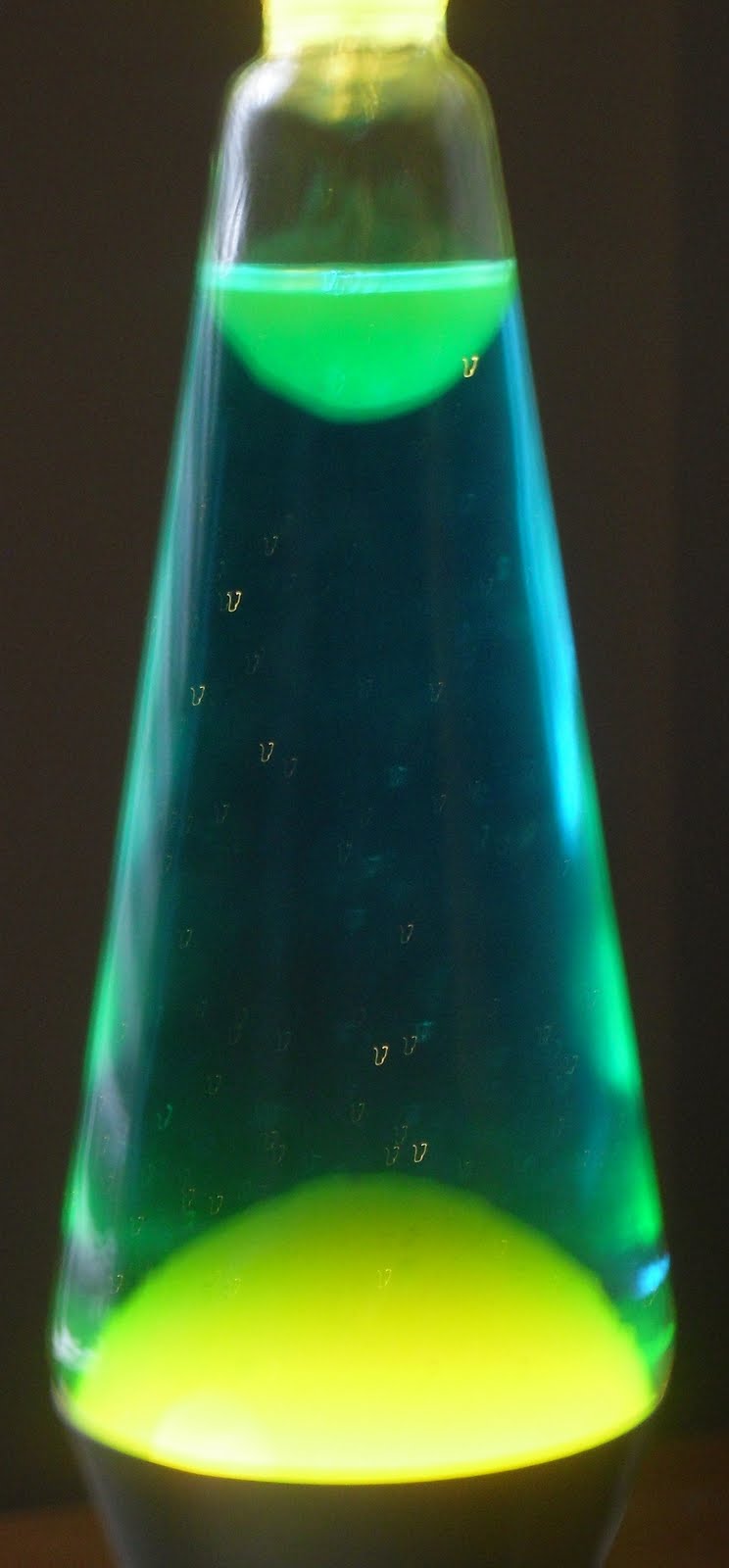


What is Catastrophe Theory? What does a lava lamp have to do with Catastrophe Theory? and What does Catastrophe Theory have to do with having sufficient for our need?
Catastrophe Theory was the brain child of Rene Thom. It is not a theory about why bad things happen. It is a mathematical theory about how to quantitatively describe sudden, discontinuous, irreversible changes. While it is a mathematical theory, the essence of the theory doesn't require math to understand. In fact, what I really like about the lava lamp is how well it demonstrates what a catastrophe is.
The essence of how a lava lamp works is that it contains blobs of wax in water that is heated by a light bulb. When the wax is cold, it is denser than the water and sinks to the bottom. When the wax warms up, it becomes less dense and rises.
Most of the time, meaning for minutes at a time, the wax in the lamp sits like it does in the first picture. It might appear at first glance that there are no changes, although if you watch closely, you can see the wax at the top and the bottom begin to change shape. The wax at the bottom bulges a little; the wax at the top starts to elongate. Then, when some magic point is reached, either the top drops a bubble of wax, or a bubble of wax rises from the bottom. Sometimes they collide. Sometimes the top will send a drop and the bottom will stay put. Sometimes the bottom will send a satellite and the top will absorb it. Sometimes the various bubbles of wax will stay separated at the top or the bottom. They will then suddenly merge. After a bubble leaves the top or the bottom, it can't be stopped and turned around. A bubble never stays in the middle. But I am watching one right now that lingers at the top without making the merge with its permanent sister.
Think of this as a metaphor for other things in life. There is the potential for catastrophes to occur around us in all areas of life. Like the lava lamp, events have the potential for catastrophes to disrupt life. Housing bubbles, stock market bubbles, the melting of the Greenland ice sheet have the potential to be global catastrophes -- sudden, discontinuous, irreversible events. They are all just waiting to change, being gradually pushed to the point of catastrophe. There are also smaller catastrophes like the suicide of a friend's teenage son, the loss of a beehive, and blight on potatoes. Like the first stage of the lava lamp, we generally see a little expansion or contraction and assume that life will continue or that we can deal with it. But then the moment of catastrophe is passed.
What does this have to do with having sufficient for our need? I think the catastrophe model -- sudden, discontinuous, irreversible change -- is what we need to prepare for. Smart people need to learn to become aware of the signs the mark the onset of catastrophes before they occur and figure out how to change course before the point of catastrophe or, at least, prepare to survive it. It's only before the point of catastrophe that something can be done. Sensing it coming and acting is crucial to avoiding or surviving its effects. It's something I've been thinking about for some time. Little by little I hope to explore this.
Subscribe to:
Posts (Atom)